It’s never too late to have a happy childhood.
—Anonymous
parenting has evolved significantly over the ages. I imagine that the act of parenting today would seem positively alien to our anatomically modern ancestors from 300,000 years ago. back then, our baseline directive seemed clear: ensure humanity doesn’t die out with your birth—reproduce—designed as we were to be biological baby factories.
since our backyard moonlights as a water monitor nursery, part of my daily routine involves observing the life and times of reptilian babies in the wild. it always strikes me how utterly solo their existence is. one of our residents is but a tiny babe—presumably the lone survivor from that batch—who lives below the deck next to our porch. unlike its juvenile neighbour, which is bold enough to move house whenever the mood strikes and has no problem going about its life as we go about ours (which, for both groups, seems to involve swimming in the pool or checking out some fish in the pond, albeit for vastly different reasons), the baby is incredibly skittish. it’s so terrified of our cat (who wants nothing but to make friends) that, when sunbathing, it only peeks its head out from underneath the wooden slabs. while it sucks seeing the baby so overly cautious—knowing no harm will come to it as long as we can help—it’s given me good mind fodder for reflecting on what parenting is all about.
whether we’re talking about us from aeons ago or today’s decidedly more conscious Homo sapiens—or reptilian brains from then till now—reproduction is how a species continues. parenting involves investing in the survival and development of its young. yet our declining birth rates suggest that the decision to reproduce involves more than a mere biological imperative; who knew the state of the economy and the joys of living in late-stage capitalism would prove stronger than our genes’ drive to perpetuate.
what, then, is parenting in this day and age? or rather, what is it becoming? for it’s an ever-changing phenomenon, moving from a duty to the future to a gift to ourselves. where the actual children who colour this spectrum come in is yet to be seen; turns out parenting is a lot less about them kids than one might imagine.
I turn, as I always do to make sense of it all, to etymology. the word ‘parent’ as we use it today has its erstwhile origins in the Proto-Indo-European root pere-, meaning ‘to produce’. while we can wax lyrical about the highs and lows of what is produced, producing a child and parenting one are two very different undertakings.
the English noun arrived through Old French and Latin parens—related to parere, ‘to bring forth’—by the early fifteenth century. by the 1660s, it was also a verb: to be or act as a parent to someone. by the 1930s, we played around with parentcraft, a fitting word for anyone who’s had enough fights with their Terrible Twos and their teens to realise that parenting is an acquired skill, not a magic gift bestowed on us at birth. the intransitive sense of ‘be a parent’ is recorded by 1959.
you can parent a child; you can also simply parent.
for me, parenting is a sacred duty, a role I step into like an artist donning an apron when working an easel. but it’s also an identity: something I’m responsible for, something I do, and part of who I am. while you’re raising someone else, the experience can change who you become. alongside the development of the child, the caregiver themselves is transformed.
as I’m most familiar with parenting since the Second Industrial Revolution, as the generational brethren of that era were the first to supply me with first-hand data on parent-child relations, I can’t speak (sans first doing extensive research) on whether there was a time when historical humans didn’t view parenting as a top-down authority where an adult moulds a passive object. unless you’re Gen Z or Gen Alpha, you’ve probably been told at some point or another that children should be seen and not heard. is it any wonder, then, that Millennial parents—and Gen Z to follow—are of a decidedly different persuasion? we tend to view parenting as a continuous, reciprocal loop between Us and our Minis.
it’s taken me 20 years as a parent to appreciate what Khalil Gibran said in On Children: “You are the bows from which your children as living arrows are sent forth.” that kids are independent souls who travel forward into their own futures; destinies for which parents cannot—and should not—assume all responsibility.
before that—and since—while healing from my own childhood traumas, I tended towards a philosophy whereby being a parent eclipses being anything else. that to be a parent is to be engulfed by said state of being. I blamed my parents because, for them, it wasn’t that way, and I blamed myself because for the life of me I couldn’t be just a mom. alive in me was also a breadwinner, a creative, and a spirit in my own right. in short, I took the whole parenting thing (on either side) too damn far.
embroiled in the throes of Empty Nest Syndrome as I am, I had to break it down. if parenting is simultaneously a duty, a role, and an identity, what does that look like? what notes do we need to hit, what boxes do we check? and who is it actually for?
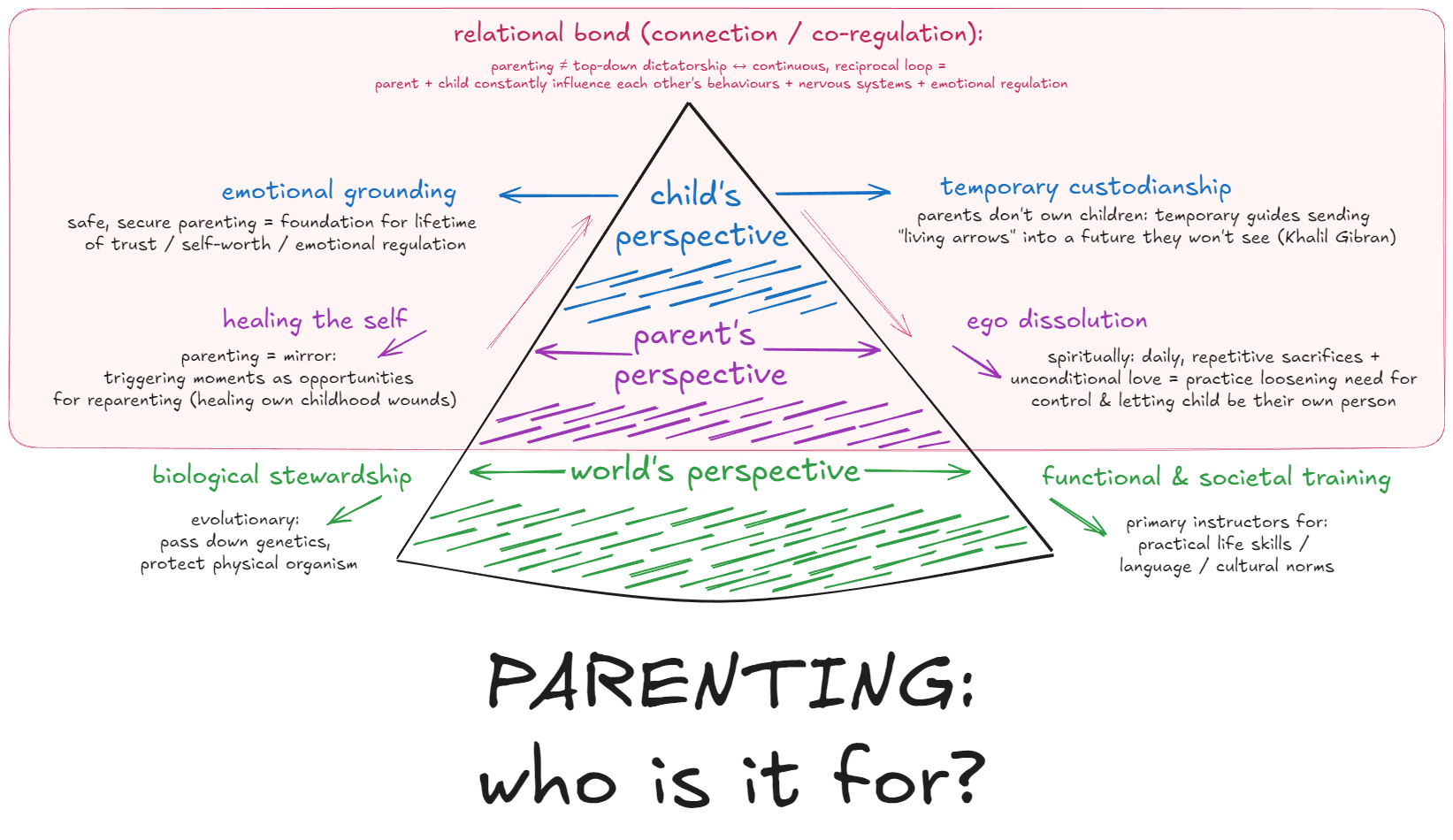
parenting rests on biological and social foundations, offers opportunities for the parent’s growth, and carries a responsibility to put the child’s needs first.
parenting seems to have a helluva lot more to do with other people than with the kid themselves. the species is happy; our offspring means our genes get to live to die another day. the world gets its pound of flesh; parents (if they’re doing it right) churn out civilised, socialised members of society. from the parent’s perspective, there’s lifelong opportunity for self-healing and ego dissolution—the stuff self-help dreams are made of, regardless of how scarred the child might be left in the process. that’s the trap: the child can bring our wounds to the surface, but the work of healing them is ours.
the kid? good stuff, if they’re lucky. if their parents were well enough, present enough, functioning enough, to give them what they need in terms of emotional grounding to go out there and conquer the world (or whatever following their dreams may look like). otherwise, a whole lotta material to take to therapy. for some, becoming a parent—biologically, adoptively, and/or communally—offers a chance to cash in a cheque that pays healing dividends.
at its best, parenting represents a two-way, lifelong relational vehicle for mutual growth and psychological healing. it can act as a psychological mirror where the child acts as a catalyst for the parent’s development by triggering their moms’ and dads’ unresolved childhood wounds1 Ghosts in the Nursery: A Psychoanalytic Approach to the Problems of Impaired Infant-Mother Relationships .
parenting, then, has come to offer parents the chance to—in the process of raising a child—ultimately finish raising themselves2 Wanting to provide the childhood they never got – a meta-synthesis of how survivors of childhood abuse experience becoming a parent .
good news for you-as-parent. but what about you-as-child? someone once told me that becoming a parent is a sure-fire way to forgive your parents because it offers a new perspective on them; you realise they’re as fallible as the rest of us and, chances are, they knew not what they were doing. forgiveness and healing are, of course, a lot more complex than that, but it does speak to the power of shifting perspective.
so, if you aren’t already, consider what parenting could mean for you. that doesn’t mean you need to be the progenitor supplying the DNA, nor does it imply your child has to be human. parenting, ultimately, is behavioural. you invest time, energy, and resources to raise, protect, and support a living organism. this might be your own child, or someone else’s. it might be a pet, or animals on the street. it might even be you, for in the end, we could all use more self-parenting.
for more perspectives on the concept of parenting, see IndieWeb Carnival September 2026: Parenting, hosted by winther blog, of which this post is part.
#100DaysToOffload/3